
Scrandle Rules Explained
Scrandle looks simple on the surface, but the game is not really about picking the food you would rather eat. The core idea is to look at two real stadium food items and predict which one earned the higher community rating. That small difference matters, because the best-looking or most expensive option does not always win.
Different versions of Scrandle may change the format or difficulty, but the basic logic stays the same. This guide covers the parts that short game descriptions usually skip: how the rating logic works, how the daily format is structured, what Evil Mode changes, and the mistakes new players make most often.
Quick answer
In Scrandle, you are shown two stadium foods and must choose the one that was rated higher by the community. You are predicting the crowd's judgment, not expressing your own taste.
Basic Scrandle Rules
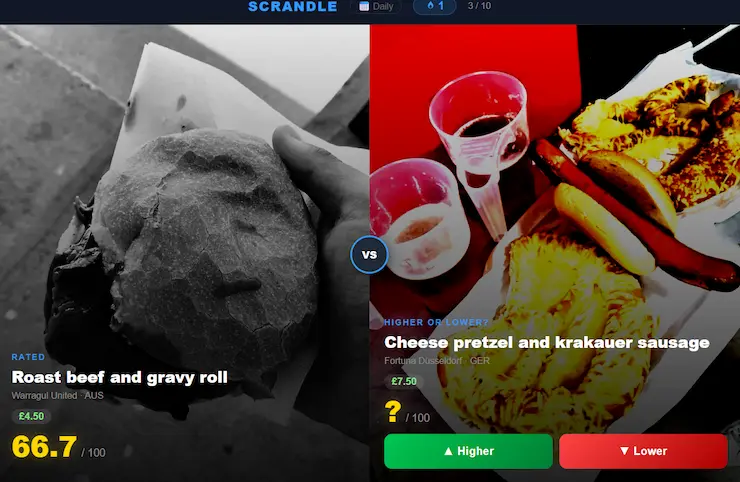
- You are shown two different football stadium food items, often called scrans.
- Each option usually includes a photo and supporting context such as price, club, or location.
- Your job is to pick the item with the higher existing community rating.
- A correct pick keeps you moving through the round. A wrong pick ends the run or costs you the matchup, depending on the mode.
- The real challenge is reading what the community rewarded, not just what looks most premium.
How Scrandle Scoring Really Works
This is the part many players misunderstand. Scrandle is not asking people to vote between the two foods you see on screen in that moment. Instead, each food item already has its own community score. The game simply puts two rated items side by side and asks you to identify which one came out better.
That means you should think in terms of public reaction, not pure food quality. A messy but generous plate at a modest price can beat a cleaner-looking item if fans saw it as better value, more satisfying, or more iconic for that ground.
- It is not a live head-to-head vote.
- It is not a chef's review or editorial ranking.
- It is not only about appearance.
- It is a comparison of two foods that already have separate crowd ratings.
Daily Mode, Practice Play, and Evil Mode
Daily Mode
Daily mode is the standard Scrandle experience. You get that day's set of matchups and try to finish with the best possible result. This is the mode most closely tied to the familiar daily-game format.
Practice Play
Practice play focuses less on a single daily card and more on seeing enough matchups to understand the game's rhythm. It is useful because repeated comparisons help you build an instinct for which types of scran the community tends to reward.
Evil Mode
Evil Mode makes the game harder by giving you less obvious comparisons. In standard play, one option may sometimes feel clearly stronger. In Evil Mode, those easy reads become rarer. The two foods can be closer in quality, value, or visual appeal, which means lazy heuristics break down fast.
If normal Scrandle is about fast intuition, Evil Mode is more about avoiding overconfidence.
Common Mistakes Players Make
- Picking the item they personally want to eat instead of the one the community probably rewarded.
- Assuming the more expensive dish must be rated higher.
- Trusting presentation too much and ignoring value for money.
- Believing the bigger club or better-known venue automatically wins.
- Playing Evil Mode with the same shortcuts that work in easier matchups.
Practical Tips for Better Guesses
- Think about value. Stadium food that looks generous for the price often performs well with fans.
- Watch for complete meals. A balanced plate can beat a flashy but limited option.
- Consider crowd appeal. Comfort food with obvious satisfaction can score better than novelty.
- Use the club and country as context, but not as a shortcut. Local culture helps, stereotypes do not.
- When two options look close, assume the community may have rewarded consistency and value over ambition.
Frequently Asked Questions
Are you choosing the better food or the higher-rated food?
You are choosing the higher-rated food. Those are not always the same thing. The winning choice is whatever the community scored better overall.
Does Scrandle compare foods in a live vote?
No. The game uses existing ratings attached to individual foods. Your task is to predict which item already had the stronger reception.
Is price important in Scrandle?
Yes, but only as a clue. A lower-priced item can overperform if fans thought it offered strong value, while an expensive plate can disappoint if it looked poor for the money.
What is the best way to start as a new player?
Start in the standard daily game, focus on value and crowd appeal, and do not overrate polished presentation. After a few rounds, the logic becomes more intuitive.
Should I read this page instead of just playing?
Playing a few rounds is still the fastest way to get the feel of Scrandle, but this guide is useful if you want to understand the logic behind the results.
Play and Related Pages
You can jump straight into the main Scrandle game, or try the alternate variant in Scrandle 2.